How to Choose a Coloring Template
Match a template to your available time and the amount of detail you want, without turning selection into another task.
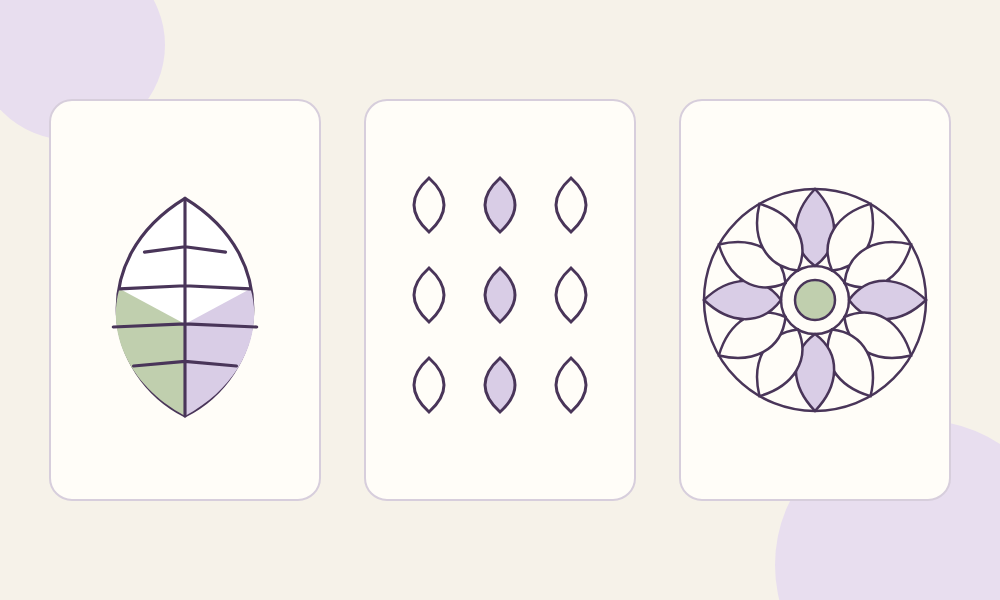
Choose for the session you have
A beautiful preview does not always make a useful starting point. Before choosing a coloring template, ask how long you want to spend and how much detail you feel like following. A large design with open areas can be quicker to begin than a tiny image packed with narrow shapes.
There is no best level of complexity. The aim is to find an outline whose next step looks inviting. You can choose a different design tomorrow or color only a small portion today. Finishing the page is not necessary.
Look at the size and density of the areas
Rather than counting objects, inspect the spaces you would actually fill. Consider the following three common types.
- Open shapes: A leaf with a few broad sections offers clear places to begin. It suits a short session or someone who wants fewer small boundaries to follow.
- Repeated patterns: Rows of petals or geometric shapes let you repeat a color choice. You can fill one row and stop, making the work easy to divide into parts.
- Dense designs: A detailed circular pattern contains many small decisions. Choose it when you want to explore detail, not because complexity seems more accomplished.
Match a template to a real time window
For five minutes, try one broad section of a leaf. For fifteen minutes, choose a small group of repeating shapes and alternate two colors. For a longer session, begin with one ring of a detailed circular pattern. These are examples, not deadlines: the pace depends on your tools, choices and attention. You can stop halfway through any section.
Use a quick selection routine
A short routine can prevent browsing from taking up the whole session. Choose among a few possibilities instead of searching for a perfect design.
- Name your time window and choose a small or large area accordingly. Do not estimate progress by the size of the whole picture alone.
- Look for one area you genuinely want to color first. If nothing attracts you, choose another outline rather than forcing interest.
- Begin with one or two colors. You can introduce more later, but a smaller initial palette reduces decisions at the start.
- After a few marks, check whether the boundaries and detail suit you. Switch designs, zoom if your tool allows it, or stop if the task feels tedious.
Common questions
Are simple templates only for beginners? No. Broad shapes can be a deliberate choice at any experience level. A simpler outline gives more room to experiment with color.
Can I leave parts white? Yes. Blank areas can remain part of the picture, and you do not need a plan for every section before beginning.
What if the template feels too detailed? Choose one larger section, leave the smaller spaces untouched or start another design. Do not treat completion as a test of patience.
Keep your choice practical
Save a small set of outlines you would like to revisit, if your chosen tool lets you do that. With MoodMirror, coloring templates are one option alongside drawing, a mood journal and optional AI reflection. Select a template for the activity you want now; its pattern does not need to reveal anything about your personality or emotions.
Make room for a little drawing
Try an open canvas or a coloring template in MoodMirror, and add a mood journal entry if you feel like reflecting.
Try MoodMirror